
1099 vs. W-2 in NC: A Guide to Worker Classification for Growing Service Firms
When you start scaling a service business in Charlotte, Huntersville, or around Lake Norman, hiring help is an exciting milestone. To keep things simple and avoid payroll overhead, many business owners hire virtual assistants, copywriters, or specialized subcontractors and pay them as “independent contractors” (1099s).
It feels like a clean solution: they send you an invoice, you pay it, and at year-end, you send them a Form 1099-NEC.
However, paying someone as a contractor is not a personal choice or a simple agreement between two parties. It is a legal classification governed by federal standards and state enforcement through agencies like the North Carolina Department of Employment Security (DES) and the North Carolina Department of Labor (NCDOL). If you direct their working hours, provide their software, or treat them like core team members, your business faces significant compliance risks.
What Is the Difference Between a 1099 Contractor and a W-2 Employee in North Carolina?
An independent contractor (1099) runs an autonomous business, sets their own schedule, uses their own tools, and offers services to the open market. A W-2 employee performs work under your direct behavioral and financial control, using your tools and systems to deliver a core service of your business.
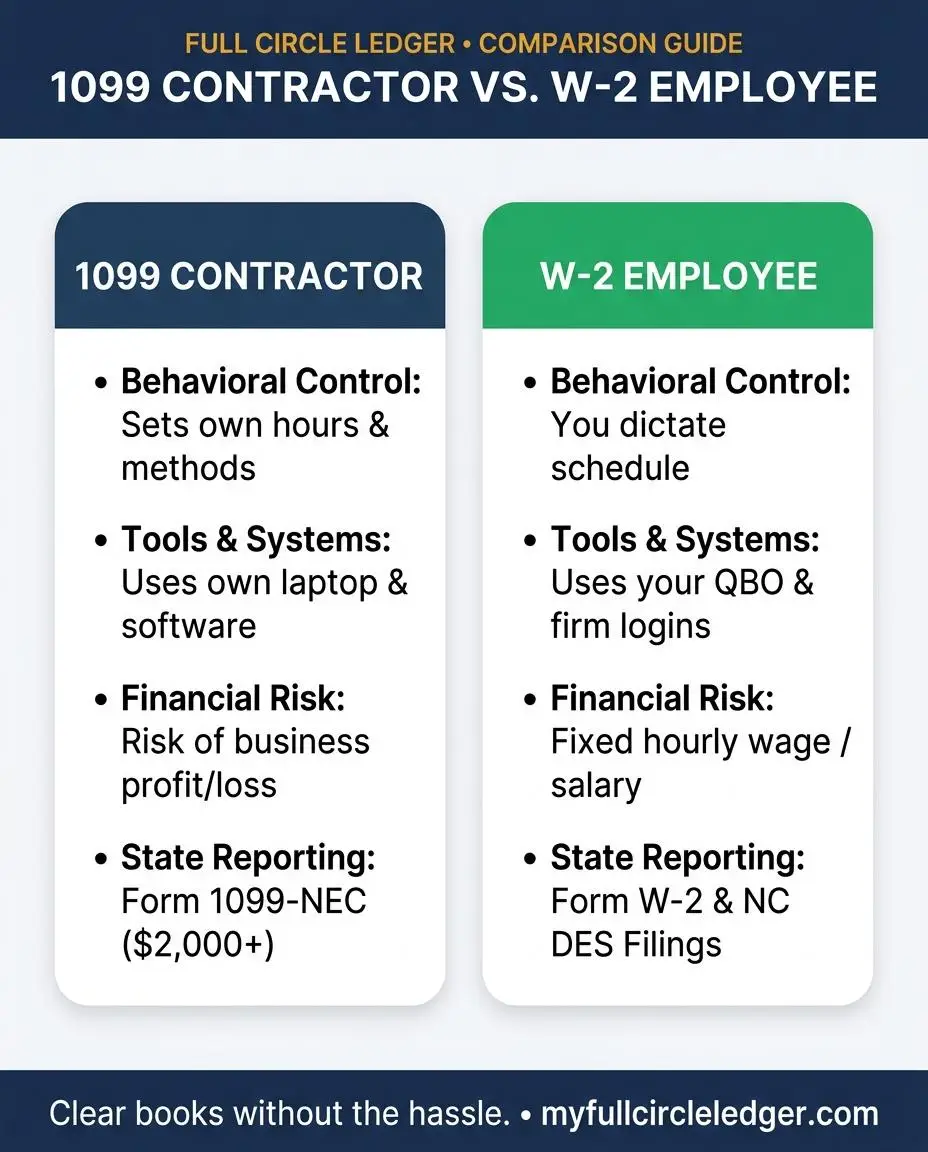
NC Worker Classification Overview
- 1099 Independent Contractor: Sets own hours and methods; uses their own equipment; bears real risk of business profit or loss; reported on Form 1099-NEC (new guidance for 2026: $2,000+).
- W-2 Employee: Schedule dictated by employer; uses employer-provided software and equipment; paid a fixed hourly rate or salary; reported on Form W-2 and Form 941 with NC DES unemployment oversight.
Evaluating Worker Classification: The U.S. Supreme Court Standard
According to the North Carolina Department of Labor, there is no single rule or definitive test that determines whether a worker is an independent contractor or an employee. Instead, regulatory agencies and courts evaluate the totality of circumstances using significant factors established by the U.S. Supreme Court.
No single factor controls the outcome. Key areas of evaluation include:
1. Behavioral Control (Degrees of Direction)
If you train the worker, dictate their exact working hours, specify the sequence of their tasks, or require them to use your proprietary software tools, regulatory agencies view the relationship as employment. True independent contractors control how the work is accomplished.
2. Financial Control & Economic Realities
Does the worker have a significant investment in their own business infrastructure, equipment, and marketing? Do they realize an opportunity for profit or a risk of loss based on their managerial skill? If a worker has no unreimbursed business expenses and relies on your firm as their primary income source, they lean heavily toward W-2 status.
3. Permanency and Type of Relationship
If a contractor performs a service that is central to your primary business offer—or if the relationship is indefinite and continuous rather than project-based—state regulatory bodies view that person as integrated into core operations.
4. Tax and Reporting Compliance
According to IRS Publication 1099, when independent contractors paid $2,000 or more in a calendar year, you must collect a Form W-9 for your internal records before issuing payment and submit Form 1099-NEC to the IRS and recipient by January 31st. (Note: It is best practice to collect a W-9 during onboarding regardless of payment amount so you aren’t chasing tax IDs at year-end). For W-2 employees, you must withhold federal and NC state income taxes, remit employer Social Security and Medicare matches, and file quarterly wage reports with the NC Department of Employment Security.
What Happens When Misclassification Is Flagged?
Payroll software does not flag when an employee is improperly paid as a contractor; it simply executes the transaction you enter.
When a worker applies for unemployment benefits or files a wage claim, state and federal agencies evaluate the underlying relationship. If misclassification occurred, agencies can assess back taxes, unpaid NC DES unemployment contributions, mandatory interest, and state penalties that reach back multiple tax years.
How Full Circle Ledger Keeps Your Payroll & 1099s Compliant
Managing payroll schedules and contractor filings shouldn’t require a full HR department—or hours spent deciphering changing state and federal regulations. At Full Circle Ledger, compliance isn’t an afterthought tacked onto year-end tax season; it is built directly into structured, flat-rate monthly bookkeeping plans designed to scale with your team.
Rather than paying for complex services you don’t need or getting hit with surprise bills when you hire your first subcontractor, compliance support expands naturally as your business grows:
- Essential Solopreneur Baseline: For new LLCs and solopreneurs operating without employees or subcontractors, bookkeeping focuses on accurate transaction tracking and reconciliation—keeping administrative costs low while laying a clean foundation.
- Growing Teams & Contractor Support: As you bring on team members, payroll processing and 1099 compliance kick in seamlessly. Up to defined payee limits, Full Circle Ledger handles ongoing payroll execution, proper W-9 collection during onboarding, state sales tax filings, and annual 1099-NEC e-filing directly with the IRS and NC agencies.
- Expanded Operations: For established firms with higher transaction volumes and larger teams, expanded payee and contractor coverage provides priority monthly reporting closes, multi-state support, and active oversight to ensure worker classifications remain compliant as team roles evolve.
- Clean-Ups & Historical Adjustments: If worker misclassifications or past-due filings need fixing before tax season, custom setup and clean-up options bring your books up to date cleanly and efficiently.
By pairing predictable, flat-rate pricing with tiered compliance thresholds, Full Circle Ledger ensures your firm gets exact-fit payroll and 1099 management at every stage of growth—helping minimize your business from costly state and federal penalties. Check out my pricing estimate page for a starting point.
Protect Your Business Growth
Proper worker classification isn’t about administrative red tape—it is about building an operational foundation so your business can scale smoothly.
When you hand over your records to a dedicated spreadsheet geek, you get clear financial statements, accurate 1099 reporting, and peace of mind knowing your ledger is tax-ready.
About Darlene Rathman
Darlene Rathman is the owner of Full Circle Ledger in Huntersville, North Carolina. She provides QuickBooks Online setup, cleanup, and monthly bookkeeping for small businesses in Huntersville, Charlotte, the Lake Norman area, and virtually when the engagement is a good fit.
She holds a B.S. in Finance, an Intuit Bookkeeping Certification, and a QuickBooks ProAdvisor Level 2 Certification. She is also a Certified Bookkeeper through Central Piedmont Community College.